

Online gambling laws change from country to country and even between states in the US. What’s legal in one place might be restricted or banned in another. Understanding where you can legally gamble online helps you stay within the law and protect yourself.
In the United States, only seven states have legalized online casinos as of 2026, while online sports betting is legal in over 30 states. The rules depend on where you live. Some states allow all types of online gambling, while others only permit sports betting or no online gambling at all.
This guide breaks down online gambling laws around the world. You’ll learn which countries allow online gambling, how US state laws differ, what the rules are in Europe, and what factors influence gambling laws in different places.
Countries Where Online Gambling Is Legal
Online gambling legality varies significantly across the world, with some nations offering full regulation and licensing frameworks while others maintain partial restrictions or outright bans. Understanding where you can legally operate or participate in online gambling depends on the specific country’s regulatory approach and enforcement mechanisms.
Fully Regulated Online Gambling Jurisdictions
Several countries have established comprehensive legal frameworks for online gambling with dedicated licensing authorities and consumer protections.
The United Kingdom operates one of the most mature regulatory systems through the UK Gambling Commission. All operators must obtain a license to serve UK customers, and the framework covers casinos, sports betting, and poker.
Malta serves as both a hub for operators and a fully legal market for players. The Malta Gaming Authority issues licenses that are recognized across the European Union and enforces strict compliance standards.
Other fully regulated markets include:
- Gibraltar – Small jurisdiction with strong regulatory oversight
- Denmark – Requires local licensing through Spillemyndigheden
- Sweden – Reformed its laws in 2019 with mandatory licensing
- Belgium – Strictly regulated with limited licenses
- Netherlands – Opened its regulated market in 2021
Australia permits online sports betting but blocks online casino operations under the Interactive Gambling Act of 2001.
Countries With Partial Legalization
Many countries allow some forms of online gambling while restricting others, creating complex regulatory environments.
The United States operates under a state-by-state system. You can access legal online casinos in New Jersey, Pennsylvania, Michigan, West Virginia, Connecticut, and Delaware. Sports betting is legal in over 30 states, but online poker remains limited to just a few jurisdictions.
Canada follows a similar provincial approach. Some provinces run their own platforms while others allow private operators. The federal government updated its Criminal Code in 2021 to support provincial regulation.
Germany legalized online poker and sports betting in 2021 but maintains strict limits on casino games and slot machines. Each state can implement additional restrictions.
India allows skill-based games in most states but restricts casino-style gambling. The legal status varies by state, with Sikkim and Goa offering some regulated options.
Recent Legalization Trends Globally
Several countries have moved toward legalization or expanded their existing frameworks between 2024 and 2026.
Brazil passed comprehensive gambling legislation that is expected to launch a fully regulated market in 2026. The country will issue licenses for sports betting and online casinos, representing one of the largest new markets in recent years.
Argentina continues expanding provincial licensing, with several provinces issuing their own online gambling permits since 2024.
Ontario, Canada launched its regulated iGaming market in 2022 and has seen steady growth with dozens of licensed operators now serving the province.
Greece modernized its gambling laws and began issuing new online licenses through the Hellenic Gaming Commission. The updated framework makes it easier for international operators to enter the market legally.
Several African nations including Kenya and South Africa have strengthened their regulatory frameworks, though enforcement remains inconsistent in some regions.
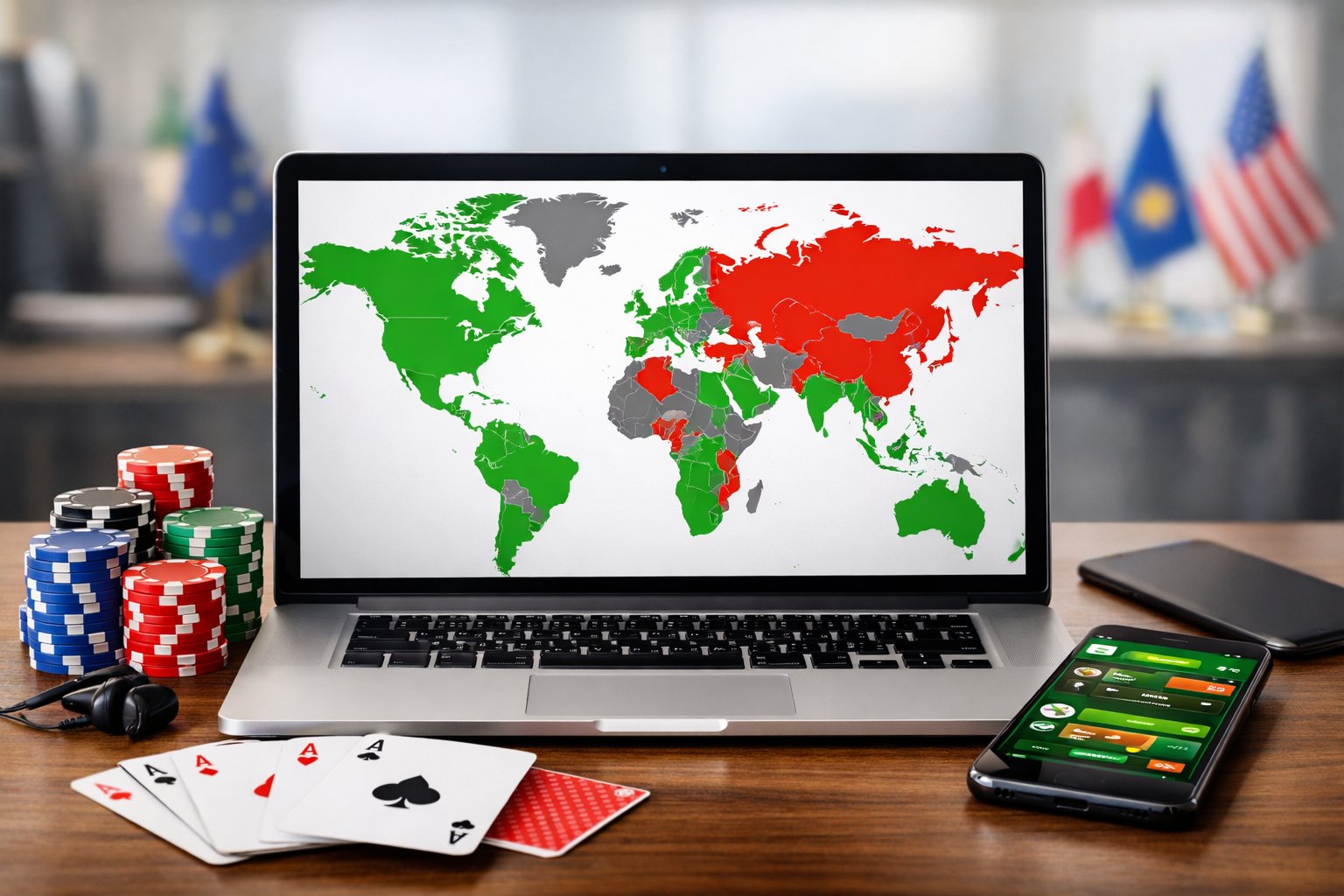
United States: State-By-State Online Gambling Laws
Online gambling laws in the United States change from state to state. Eight states allow full online casino gaming, while many others permit sports betting or poker only.
States With Full Legalization
Eight states have legalized all forms of online gambling, including casino games, poker, and sports betting. These states are New Jersey, Pennsylvania, Michigan, Delaware, West Virginia, Connecticut, Rhode Island, and Maine.
New Jersey leads the market and launched online casinos in 2013. The state offers the most variety of online gambling options. Pennsylvania and Michigan both have large online casino markets with many operators.
Delaware was the first state to legalize online gambling in 2012. West Virginia, Connecticut, and Rhode Island followed with their own online casino programs. Maine is the most recent addition to full legalization.
These states let you play slots, table games, poker, and place sports bets through licensed online platforms. Each state requires operators to have licenses and follow strict rules.
States Allowing Limited Forms of Online Gambling
Many states allow only sports betting or lottery sales online. Over 30 states have legalized online sports betting since 2018.
States like New York, Illinois, and Massachusetts let you bet on sports through apps but do not allow online casinos. These states generate revenue from sports betting while keeping other forms of online gambling illegal.
Some states only permit online lottery ticket sales. Others allow daily fantasy sports but consider it a game of skill rather than gambling.
The rules vary widely. You need to check your specific state’s laws to know what types of online gambling you can legally access.
Pending Legislation and Proposed Changes
Several states are considering bills to expand online gambling. New York has discussed legalizing online casinos to match its sports betting success.
States like Indiana, Maryland, and Ohio are reviewing proposals to add online casino gaming. These bills move through state legislatures at different speeds.
Some states face opposition from land-based casinos or tribal gaming operations. This slows down the process of passing new laws. Other states worry about problem gambling and want more research before expanding options.
The federal government has not passed new gambling laws recently. Each state continues to make its own decisions about online gambling.
Online Gambling Legality in the European Union
The EU does not have unified gambling laws. Each member state controls its own online gambling regulations, creating a patchwork of different legal frameworks across the continent.
Countries With National Regulation
Many EU countries have established their own licensing systems for online gambling. These nations require operators to obtain a local license to legally offer services to their residents.
Countries with national regulatory frameworks include:
- Germany – Legalized online gambling with strict advertising limits and deposit caps
- France – Permits online sports betting, poker, and horse racing through licensed operators
- Spain – Maintains a licensing system for online casinos and sports betting
- Italy – Operates one of Europe’s most developed regulatory systems
- Netherlands – Launched its regulated market in 2021 with mandatory licensing
- Denmark – Established licensing requirements in 2012
- Sweden – Reformed its gambling laws in 2019 to include online operators
These countries tax gambling revenue and enforce consumer protection standards. You must use operators licensed in these specific jurisdictions when gambling from these nations.
Countries Permitting International Operators
Several EU nations allow their residents to access online gambling sites licensed in other jurisdictions. Malta and Gibraltar serve as popular licensing hubs that many operators use to serve European players.
Malta’s Gaming Authority is one of the most recognized licensing bodies in Europe. Operators with a Malta license can often serve players in countries without strict local licensing requirements.
Cyprus, Estonia, and Romania accept international licenses under certain conditions. These countries have less restrictive frameworks but still maintain some oversight of gambling activities.
Some nations operate under a “grey market” approach where online gambling isn’t explicitly regulated but also isn’t actively blocked. This creates legal uncertainty for both operators and players.
Significant Legal Differences Across The EU
Licensing requirements vary dramatically between countries. France limits online casinos but allows sports betting, while Germany permits both with strict restrictions. Poland heavily restricts online gambling, making most international operators technically illegal.
Tax rates differ substantially across member states. Denmark taxes gross gaming revenue at 20%, while other countries use different models based on player losses or total stakes.
Key regulatory differences include:
- Advertising restrictions ranging from complete bans to minimal oversight
- Player deposit limits that some countries mandate and others don’t
- Game type availability varying by jurisdiction
- Cross-border service rules that remain inconsistent
The European Commission supports cooperation between national regulators but cannot force unified standards. This means you face different rules, protections, and legal gambling options depending on which EU country you’re in.
Online Gambling Restrictions Worldwide
Several nations enforce complete bans on online gambling, implementing harsh penalties for violations and using technology to block access to gambling websites. The severity of restrictions varies widely, from criminal charges and imprisonment to financial penalties and internet service provider blocks.
Countries With Strict Prohibitions
China maintains one of the world’s strictest anti-gambling stances. All forms of online gambling are illegal, with no exceptions for foreign operators or domestic platforms.
The United Arab Emirates prohibits online gambling entirely based on Islamic law. You face serious legal consequences if caught participating in any form of internet betting or casino games.
North Korea bans all gambling activities for its citizens. The country only permits state-run casinos that exclusively serve foreign tourists.
Brunei enforces Islamic Sharia law, which completely forbids gambling. Online gambling carries the same prohibition as land-based gambling.
Cambodia previously allowed some online gambling operations but banned all online gambling in 2019. The government shut down existing licenses and prohibited new applications.
Qatar follows strict Islamic principles that ban all gambling activities. You cannot legally access online casinos or betting sites within the country.
Criminal and Civil Penalties by Jurisdiction
Singapore imposes fines up to SGD 5,000 or imprisonment for up to six months for individuals caught gambling on unauthorized websites. Operators face much steeper penalties including lengthy prison sentences.
South Korea prosecutes both operators and players. You could face up to five years in prison or fines reaching 50 million won for operating illegal gambling sites. Players typically receive smaller fines.
Poland targets unlicensed operators with fines up to 12.8 million euros. The country maintains a registry of banned gambling domains and requires internet service providers to block these sites.
Turkey penalizes illegal gambling operators with prison sentences ranging from two to five years. Financial institutions must also block transactions to unlicensed gambling sites.
Technological Barriers to Access
Many countries use IP blocking to prevent access to unauthorized gambling websites. Your internet service provider receives government orders to block specific domain names and IP addresses.
DNS filtering redirects traffic from banned gambling sites to warning pages. China, Turkey, and several Middle Eastern nations employ this method extensively.
Payment processing restrictions prevent banks and credit card companies from processing transactions with offshore gambling operators. You cannot complete deposits or withdrawals even if you access the sites through VPNs.
Some jurisdictions implement deep packet inspection technology that identifies and blocks gambling-related traffic patterns. This advanced filtering detects encrypted connections to known gambling servers.
Factors Affecting Online Gambling Legality
Online gambling laws in the United States depend on the type of gambling activity, state-specific licensing systems, and strict player verification standards. Each state creates its own rules for who can operate gambling sites and who can play.
Types of Online Gambling Regulated
States treat different forms of online gambling differently. Sports betting has become legal in more states than online casinos. As of February 2026, over 30 states allow online sports betting, while fewer than 10 states permit online casino games.
Online poker falls into a separate category in some states. New Jersey, Delaware, Nevada, Pennsylvania, Michigan, and West Virginia allow online poker rooms. These states often share player pools across state lines through interstate compacts.
Daily fantasy sports exist in a legal gray area. Most states consider DFS a game of skill rather than gambling. This distinction means DFS platforms operate in states that ban traditional online gambling.
State legislatures decide which activities to permit based on their priorities. Some focus only on sports betting revenue. Others approve full casino gaming with slots, table games, and poker.
Licensing Requirements
You can only gamble legally on sites that hold valid state licenses. Each state sets its own licensing standards for operators. The application process typically costs hundreds of thousands to millions of dollars.
Operators must prove financial stability and pass background checks. They need to demonstrate proper security measures and fair gaming systems. States also require companies to partner with existing land-based casinos or racetracks in many jurisdictions.
Key licensing requirements include:
- Background investigations of company owners and executives
- Proof of adequate financial reserves
- Gaming system testing and certification
- Responsible gambling program implementation
- Tax payment agreements with the state
Tribal casinos operate under different rules. They negotiate gaming compacts directly with state governments. These compacts give tribes authority to offer online gambling to players within state borders.
Age and Identity Verification Laws
Every legal gambling state requires players to be at least 21 years old. You must verify your age and identity before placing real money bets. Operators use multiple verification methods to confirm you meet legal requirements.
Standard verification steps include:
- Government-issued ID submission
- Social Security number verification
- Geolocation tracking to confirm you’re within state borders
- Database checks against public records
Sites use GPS technology to verify your physical location when you log in. You cannot access gambling sites if you travel to states where online gambling is illegal. The geolocation software blocks access automatically.
If you fail identity verification, your account gets suspended. You’ll need to provide additional documentation to prove your identity and age. Operators face serious penalties for allowing underage or out-of-state gambling.