
Searchable.com tracks how brands appear across several AI answer engines, and the company’s own research keeps returning to one finding: the engines do not behave alike. A brand can turn up often in ChatGPT answers and rarely in Gemini’s, or earn links in Perplexity while missing from Google’s AI Overviews.
This comparison puts the main engines side by side on the same points. It leans on official documentation where it exists and on Searchable’s studies where it does not, and those studies are reported as the company’s own research.
Seven Answer Engines Compared on the Same Points
The table summarises what is documented for each engine. The coverage column follows Searchable’s pricing page, which is narrower than the engine list on its home page.
| Engine | Where answers come from | What official or Searchable sources document | Searchable plan coverage |
|---|---|---|---|
| ChatGPT | Training data plus live search through retrieval | OAI-SearchBot surfaces sites in ChatGPT search; GPTBot crawls for training | Core |
| Google AI Overviews | Google’s index, with possible query fan-out | No special optimizations beyond indexing and snippet eligibility | Core |
| Google AI Mode | Google’s index, as opt-in chat search with query fan-out | The same Google guidance as AI Overviews | Not named on the pricing page |
| Perplexity | Sites surfaced and linked by PerplexityBot | PerplexityBot surfaces and links sites and is not used for model training | Core |
| Microsoft Copilot | Not stated in the sources used here; Bing reports grounding queries | Bing Webmaster Tools AI Performance report, in public preview | Add-on |
| Claude | Training data plus user-requested and search fetches | ClaudeBot, Claude-User and Claude-SearchBot, controlled through robots.txt | Add-on |
| Gemini | Not covered by the official sources used here | Searchable’s comparison study against ChatGPT | Not named on the pricing page |
How to read the coverage column
The home page FAQ names eight engines: ChatGPT, Claude, Perplexity, Google AI Overview, Microsoft Copilot, Gemini, Grok and DeepSeek. The pricing page is more specific, so this comparison follows it.
Note. “Not named on the pricing page” means exactly that and nothing more. Ask the company directly before assuming Gemini or AI Mode figures are part of a plan.
ChatGPT and Gemini Recommend Different Brands
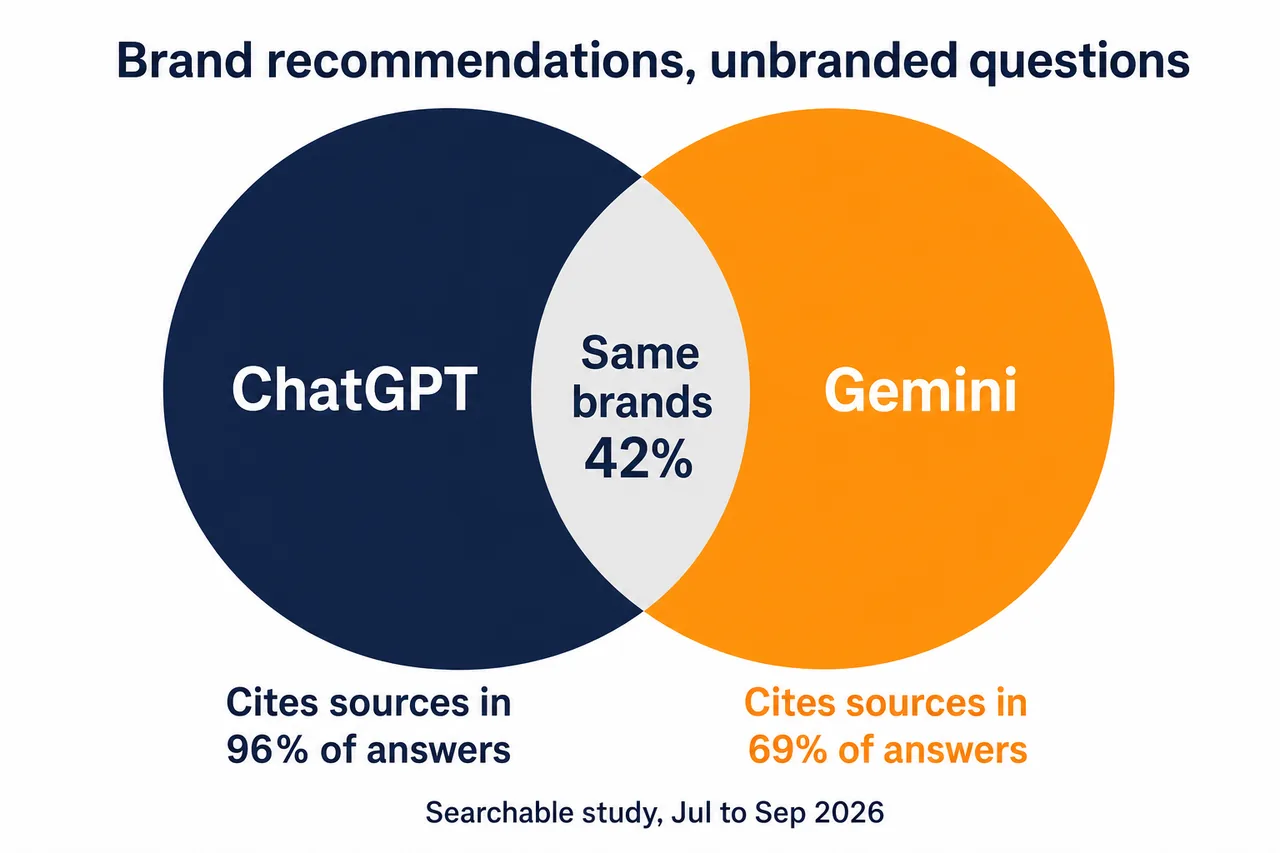
The clearest evidence of engine differences comes from a Searchable study of 38,966 unbranded questions run between 8 July and 15 September 2026. It compared 1,410,364 ChatGPT answers with 1,040,107 Gemini answers.
What the study reported
- The two engines recommended the same brands 42% of the time.
- Each engine agreed with itself 75-77% of the time across repeat runs.
- ChatGPT cited sources in 96% of answers, Gemini in 69%.
- Answers named about 3.7 brands per question.
The gap between 42% and 75-77% is the telling part. Taken at face value, disagreement between the engines is much larger than the run-to-run noise inside either one, which points to different sources and habits rather than chance.
Why the citation gap matters
The 96% and 69% figures matter as much as the brand overlap. If Gemini cited sources in 69% of answers, roughly 3 in 10 Gemini answers in the study offered no source at all that a site could have earned. With about 3.7 brands named per question, the slots that do exist are few.
Caveat. This is brand research, published by a company that sells AI visibility tracking. None of the sources used here replicate it independently.
ChatGPT Draws on Two Layers of Information
Searchable’s article on where ChatGPT gets its data describes two layers. One is training data with a cutoff. The other is live search, which works through retrieval-augmented generation.
| Point | Training layer | Live search layer |
|---|---|---|
| What it is | What the model learned before its cutoff | Pages retrieved when the question is asked |
| Freshness | Fixed at the cutoff | Current at query time |
| Related OpenAI crawler | GPTBot | OAI-SearchBot, with ChatGPT-User for user-initiated fetches |
| What OpenAI says about blocking | Disallowing GPTBot is independent of search | Allow OAI-SearchBot to appear in search answers |
The live layer is the one that moves fast. A Searchable study of 5,000+ tracked brands, covering 1 to 17 August 2026, found pages consulted per ChatGPT answer rose from 11.6 to 22.5, and Reddit’s share of answers fell from 12.6% to 1.7% on 14 August.
Where Searchable and OpenAI differ on GPTBot
Searchable’s AEO article recommends allowing AI crawlers, naming GPTBot, PerplexityBot and ClaudeBot. OpenAI’s own documentation draws a sharper line: GPTBot is for training, and OAI-SearchBot is the crawler tied to ChatGPT search. A site owner who wants search visibility without contributing training data can, by OpenAI’s account, treat the two separately.
Caveat. A shift of that size inside two weeks means a month-old reading of ChatGPT may already be out of date.
Google AI Overviews and AI Mode Share Rules but Not Format
Google’s documentation on AI features says “There are no additional requirements to appear in AI Overviews or AI Mode, nor other special optimizations necessary.” A page must be indexed and eligible to show with a snippet. Searchable’s article on AI Mode adds the difference in how each one reaches users.
| Point | AI Overviews | AI Mode |
|---|---|---|
| How it appears | Automatically on the results page | Opt-in chat search |
| Query fan-out | May be used | May be used |
| Eligibility | Indexed and snippet-eligible | Indexed and snippet-eligible |
| Preview controls | nosnippet, data-nosnippet, max-snippet, noindex | The same controls |
| Search Console reporting | Within the Web search type | Within the Web search type |
| Searchable pricing page | Core engine | Not named |
What Searchable’s AI Overviews research adds
Searchable’s article on ranking in AI Overviews says they appear mainly for informational queries. In its SERP sample, 39% of how-to citations came from top-10 results against 83% for definitional queries. Across Searchable’s articles, the overall top-10 share ranges from about 38% to about 76%.
Tip. Because Google counts AI feature traffic inside the Web search type, Search Console cannot isolate it. Settle how you will estimate AI Overviews traffic before anyone promises a number.
Perplexity Keeps Search Crawling Apart From Training
Perplexity’s documentation describes PerplexityBot as the crawler that surfaces and links sites in Perplexity results, and says it is not used for training foundation models. A second agent, Perplexity-User, supports actions that users take.
That makes Perplexity the simplest case on this list, since the crawler that matters for visibility has no training role. For Searchable users it is one of the three core engines, and it is covered by both the free visibility report and the public data hub.
Tip. If a site blocks AI bots broadly, check PerplexityBot on its own. Blocking it works against the one crawler Perplexity says it uses to surface and link sites.
Each Engine Leans on a Different Pool of Sources
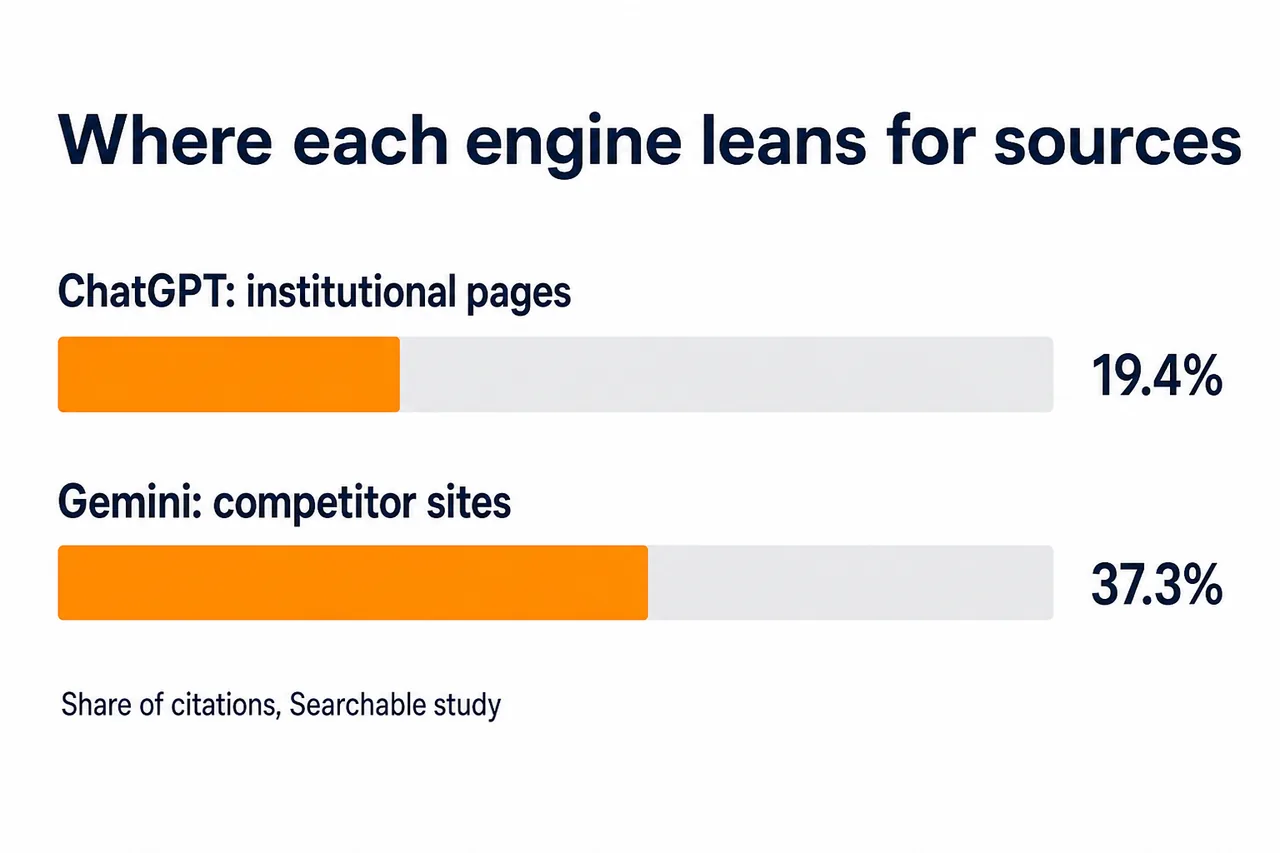
Engines differ not only in which brands they name but in which sites they read. A Searchable article on AI citations and backlinks cites Averi AI data showing only 11% domain overlap between ChatGPT and Perplexity.
Searchable’s public data hub tracks anonymized citation datasets for ChatGPT, Google AI Overviews and Perplexity, with 30-day trends updated daily. It groups cited sources into four families.
- Social and community sites
- B2B review sites
- Knowledge and reference sites
- News
Note. The hub covers the three core engines only. Source patterns for Copilot, Claude or Gemini have to come from elsewhere.
Microsoft Copilot Is the Engine Most Tied to Bing
Copilot stands out for having first-party reporting from its search partner. Bing Webmaster Tools’ AI Performance report, in public preview since 10 February 2026, covers Microsoft Copilot, AI summaries in Bing and select partners. Bing’s accompanying guidance on getting cited lists six things.
- Clear headings
- Tables
- FAQ sections
- Evidence behind claims
- Fresh content
- IndexNow and Bing Places
The report’s metrics include Total Citations, Average Cited Pages and grounding queries. Among the sources used here, no other engine operator documents citation counts for site owners.
For Searchable users, Copilot sits among the add-on engines on the pricing page, so it is not part of the core set.
Claude, Grok and DeepSeek Sit Outside the Core Searchable.com Plans
Three engines on Searchable’s home page list are extras in its pricing. Claude and Grok are add-ons, alongside Copilot. DeepSeek is listed as a custom integration, and custom engine integrations belong to the sales-led Custom plan.
Claude is the best documented of the three. Anthropic describes ClaudeBot for training, Claude-User for user requests and Claude-SearchBot for search quality, all controlled through robots.txt. Searchable’s Traffic feature also separates Claude referrals from other visits.
Warning. Searchable’s free visibility report covers Claude, but that does not mean a paid plan tracks Claude without the add-on. Check the engine list before relying on Claude figures.
For Grok and DeepSeek, the sources behind this comparison say nothing about how they choose sources, so neither gets a fuller entry here.
Engine by Engine Questions
Which engines should a team track first?
Searchable’s pricing suggests an order without saying so outright.
- Start with the core three, ChatGPT, Google AI Overviews and Perplexity.
- Add Copilot, Claude or Grok where your audience actually uses them.
- Raise DeepSeek or any other engine with sales as a custom integration.
Where do visits from ChatGPT or Perplexity show up?
Searchable’s Traffic feature connects GA4 and Search Console through OAuth and separates referrals from ChatGPT, Perplexity, Claude and others from organic search and from “direct”.
Can one content change lift visibility in every engine?
Searchable’s AEO article names four citation factors that apply broadly: extractability, corroboration, entities, and freshness and authority. But the engines read different source pools and cite at different rates, so results rarely move in step.
Example. Illustrative only. A refreshed comparison page might start appearing in Perplexity’s links within weeks while Gemini answers stay unchanged, partly because Gemini cited sources less often in Searchable’s study.
Do engines change how they cite over time?
Yes, and sometimes quickly, as the August 2026 ChatGPT study showed. Searchable says its prompts run daily across available models, which is one way to catch such shifts.
Does the free report give a fair picture of every engine?
Not of every engine. Searchable’s free visibility report covers ChatGPT, Claude and Perplexity, so it says nothing about Google AI Overviews, AI Mode, Copilot or Gemini. It is a reasonable first look at three engines and no more than that.
The Verdict on Treating AI Search as One Channel
On the evidence available, treating “AI search” as a single channel produces misleading numbers. The engines read different sources, cite at different rates and, in Searchable’s study, agreed on brands less than half the time. Even Google’s two AI features, which share eligibility rules, reach users in different ways.
What that means in practice
For a Searchable.com user, that argues for reading results engine by engine on the three core engines, adding Copilot, Claude or Grok only where the audience justifies the add-on, and treating Gemini and AI Mode coverage as a question for the company. Searchable’s figures are brand research.
They are useful, not final. The official documentation from Google, OpenAI, Perplexity, Anthropic and Bing remains the firmer ground for how each engine finds a page in the first place.